The Future of Work: How AI is Reshaping Industries
In an era of unprecedented technological transformation, artificial intelligence is fundamentally altering the landscape of work across every sector of the global economy. From factory floors to hospital wards, from newsrooms to financial trading desks, AI is not just changing how we work—it's redefining what work means in the 21st century.
The AI Revolution Has Arrived
Two years ago, artificial intelligence was still a curiosity in most workplaces. Today, it has become nearly ubiquitous. According to recent data, 91% of organizations now use at least one AI technology, and nearly 47% of workers across all sectors report using AI tools at least once a month—up from just 34% the previous year. This isn't evolution; it's revolution.
The numbers paint a striking picture of transformation. The World Economic Forum's Future of Jobs Report 2025 reveals that 40% of employers expect to reduce their workforce where AI can automate tasks, while simultaneously projecting that AI will create 11 million new jobs even as it displaces 9 million others. Industries most exposed to AI have seen productivity growth rates quadruple, with a 27% increase from 2018 to 2024 compared to just 7% before AI's emergence.
But behind these statistics lies a more nuanced story—one of workers adapting, industries transforming, and societies grappling with questions that will define the coming decades. How do we harness AI's potential while protecting workers? How do we bridge the skills gap that threatens to leave millions behind? And perhaps most importantly, how do we ensure that this technological revolution benefits everyone, not just those at the top?
The Numbers Behind the Transformation
The scale of AI's impact on the global workforce is staggering. The International Monetary Fund estimates that AI will affect nearly 40% of all jobs worldwide, with up to 300 million full-time positions potentially influenced by AI-related automation. In 2025 alone, 76,440 positions have already been eliminated due to AI, averaging roughly 491 people losing their jobs to AI every single day.
Yet the picture is far from one-dimensional. While 85 million jobs are projected to be displaced, 97 million new roles are simultaneously emerging—a net positive of 12 million positions globally. The World Economic Forum projects 170 million new jobs by 2030, nearly double the 92 million expected to be displaced, resulting in a net gain of 78 million additional positions.
The productivity gains are equally remarkable. AI users report an average 66% productivity improvement across business tasks. Since 2022, when awareness of AI's power surged, revenue growth in industries best positioned to adopt AI has nearly quadrupled. McKinsey estimates that AI could deliver an additional $13 trillion in global economic activity by 2030, representing about 16% higher cumulative GDP.
Perhaps most significantly, AI is making workers more valuable. Wages are rising twice as quickly in industries most exposed to AI compared to those least exposed, and AI-exposed industries now see three times higher growth in revenue per employee compared to less AI-integrated sectors.
Healthcare: Augmentation Over Replacement
Nowhere is the promise of AI-human collaboration more evident than in healthcare. Far from replacing doctors and nurses, AI is emerging as what one industry observer called a "superpower" for medical professionals—amplifying their abilities rather than substituting for them.
The transformation is already underway. As of 2025, 100% of U.S. healthcare systems use ambient AI technology to some degree—systems that listen to doctor-patient conversations in real-time and automatically generate clinical documentation. This technology category, known as ambient scribes, has become healthcare AI's first breakout success story, generating $600 million in 2025—a 2.4-fold increase year-over-year.
The impact on medical professionals has been transformative. Survey data shows that doctors are spending 64.76% less time on paperwork, translating to more than two hours per day reclaimed for patient care. A Duke University study found that AI transcription reduced note-taking time by approximately 20% and after-hours work by 30%. At Mass General Brigham, physicians experienced a 40% reduction in burnout within weeks of implementing AI scribes.
Major health systems are betting heavily on this future. Kaiser Permanente deployed Abridge's ambient documentation solution across 40 hospitals and more than 600 medical offices, marking the largest generative AI rollout in healthcare history and Kaiser's fastest technology implementation in over 20 years. Mayo Clinic is investing more than $1 billion in AI across over 200 projects extending beyond administrative automation to include diagnostics and patient care.
India's Apollo Hospitals has dedicated approximately 3.5% of its digital budget to AI tools that automate medical documentation and scheduling, aiming to free up two to three hours per day for healthcare professionals. AI solutions are also augmenting or replacing functions that previously required nurses and front-office staff to spend hours filling out forms or waiting on hold with insurers. Prior authorizations that once took days can now be completed in minutes.
Yet healthcare leaders are mindful of the technology's limitations. As one expert noted, there is concern that because AI technologies are so powerful, they may shortcut the ways doctors learn and develop expertise, potentially producing generations of physicians who lack traditional diagnostic reasoning skills. The consensus remains clear: AI works best as a partner to human clinicians, not a replacement for them.
Manufacturing: The Rise of Physical AI
On factory floors around the world, the integration of AI and robotics is reshaping industrial production in ways that would have seemed like science fiction just a decade ago. As of 2025, 90% of manufacturers have adopted some form of AI technology into their operations, and the numbers suggest this is only the beginning.
The global AI market in manufacturing was valued at $5.94 billion in 2024 and is projected to reach $60.7 billion by 2034. In 2025 alone, $1.2 trillion in investments toward building out U.S. production capacity was announced, led by electronics providers, pharmaceutical companies, and semiconductor manufacturers.
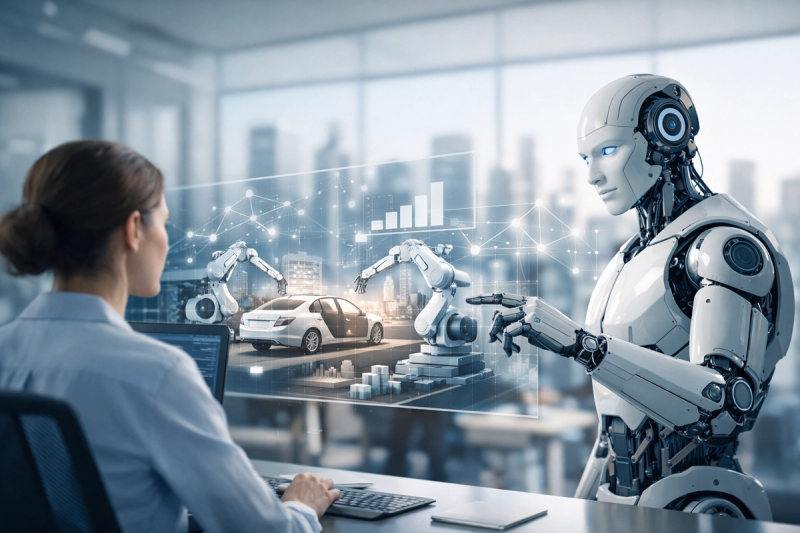
The robots themselves are evolving. No longer confined to repetitive welding or material handling, modern industrial robots are becoming adaptive, learning systems capable of adjusting in real time. The concept of "Physical AI"—robots gaining the ability to perceive, learn, and respond to complex environments—is transforming what's possible on the factory floor.
According to Rene Haas, CEO of chip designer Arm, AI-powered humanoid robots could take over large sections of factory work within the next five to 10 years. General-purpose humanoid robots, combined with increasingly sophisticated physical AI, will be able to take on different jobs on the fly with quick modifications to their instructions.
Major manufacturers are already implementing these technologies. BMW has expanded its use of collaborative robots that work directly with human technicians, handling repetitive or precision-driven tasks while reducing strain and improving accuracy. Companies including Caterpillar, Foxconn, Lucid Motors, Toyota, and TSMC are building digital twins using NVIDIA's Omniverse platform to accelerate AI-driven manufacturing.
Yet the human element remains critical. While certain repetitive or hazardous roles are being automated, new, more skilled positions are emerging. Factory operators are increasingly becoming data technicians managing interconnected systems instead of single machines. Maintenance teams are learning to interpret sensor-driven insights. A 2024 Deloitte report projected that more than 2 million manufacturing jobs in the U.S. could remain unfilled by 2030 due to the skills gap—highlighting that the challenge isn't too many workers, but too few with the right skills.
Manufacturers are responding by investing heavily in upskilling. Siemens and GE have partnered with technical colleges to train workers in robotics maintenance, machine learning, and cybersecurity. As Manpreet Hora, senior associate dean at Georgia Tech's Scheller College of Business, observed, "Manufacturing now needs workers who combine technical, digital, and soft skills."
Creative Industries: The Unprecedented Disruption
Perhaps nowhere has AI's arrival been more contentious than in the creative industries. The advent of generative AI has produced what one researcher described as a change "comparable to the advent of the printing press"—a transformation in how we produce and engage with content at a scale not seen in centuries.
In journalism, AI tools are already reshaping newsrooms. The Washington Post's AI tool, Heliograf, helped cover the 2016 Rio Olympics by generating brief sports updates and election results in real-time, allowing human journalists to focus on more in-depth stories. Reuters utilizes Lynx Insight, an AI system that assists journalists by identifying patterns in data and suggesting story angles. There are now journalist AI and blog AI writers that generate content with layouts suitable for print or online publication.
Yet this transformation raises fundamental questions about the nature of journalism itself. As one research paper noted, these changes "challenge fundamental assumptions about creativity and originality in journalism," raising questions "about the role of journalists when machines can produce content that is increasingly difficult to distinguish from human work."
In visual arts and design, tools like DALL-E, Midjourney, and Stable Diffusion have transformed the creative process, enabling artists to generate complex images from simple text prompts. NVIDIA Canvas allows designers to paint simple shapes and watch them transform into photorealistic landscapes in real-time. For writers, tools like Jasper, Writesonic, and Sudowrite help generate first drafts, headlines, and creative storylines.
The disruption has not been without conflict. In 2023, writers and actors went on strike for months in one of the longest strikes in Hollywood history, battling over the use of AI by studios in a fight to preserve human creativity. Major media organizations have pursued commercial litigation to obtain fair compensation for the use of their content to train AI algorithms—the New York Times sued OpenAI, while the Wall Street Journal filed suit against Perplexity AI. Other organizations have made bespoke agreements, with Axel Springer SE and NewsCorp signing deals with OpenAI.
Industry experts predict that in the long term, AI will significantly transform creative work, with less time spent on technical execution and more on strategic thinking and conception. The key skills in this new environment will be critical thinking, idea management, and the ability to collaborate with intelligent systems. As one analyst noted, "That doesn't mean the end of creative talent, but rather an evolution towards a more strategic and conceptual role."
The Skills Gap Crisis
As AI transforms industries, a massive skills gap threatens to leave millions of workers behind. In 2025, AI talent demand exceeds supply by a ratio of 3.2 to 1 globally, with over 1.6 million open positions and only 518,000 qualified candidates available. According to the World Economic Forum, employers expect 39% of workers' core skills to change by 2030.
The challenge is stark: 77% of new AI jobs require master's degrees, creating substantial barriers to entry. The most severe shortages exist in areas like large language model development, machine learning operations, and AI ethics—fields with demand scores above 85 out of 100 but supply below 35. Meanwhile, 120 million workers need retraining within three years, and 20 million U.S. workers are expected to retrain in new careers or AI use in the coming years.
Current training efforts may be insufficient. A 2025 OECD report argues that available training supply may not meet the growing need for general AI literacy skills. While many companies—two-thirds, according to IDC—are investing in internal training to upskill existing staff, uptake remains uneven. Budget limits, lack of trainers, and low employee engagement hamper these efforts.
The generational divide is particularly striking. Millennials lead AI usage at 56%, while only 25% of Baby Boomers engage with AI tools. Universum's research reveals that only 6% of employees feel very comfortable using AI in their roles, while nearly one-third are distinctly uncomfortable. Workers aged 18 to 24 are 129% more likely than those over 65 to worry that AI will make their jobs obsolete.
"Workforce development in the U.S. is chronically underfunded compared to peer nations," observed Rachel Lipson from Harvard University's Project on Workforce. More than half of workers identify enhanced training as the top priority for improving AI outcomes, underscoring the importance of workforce preparedness.
The skills needed for success in an AI-augmented workplace are evolving. AI literacy is now considered a "core skill" across most industries, according to the World Economic Forum. Companies increasingly prioritize technological literacy, creative thinking, and knowledge of AI, big data, and cybersecurity. Yet human-centered skills remain critical even in tech-driven workplaces—problem-solving, adaptability, and collaboration are identified as essential competencies.
The Demographic Divide
AI's impact is not distributed equally across the workforce. Women face nearly three times the risk of automation compared to men, with 58.87 million women versus 48.62 million men occupying positions highly exposed to AI automation. This disparity reflects the concentration of women in administrative, clerical, and customer service roles that are most susceptible to AI replacement.
Entry-level workers are particularly vulnerable. Unemployment among 20- to 30-year-olds in tech-exposed occupations has risen by almost 3 percentage points since the start of 2025. Employment growth in industries such as marketing consulting, graphic design, office administration, and telephone call centers has fallen below trend amid reports of reduced labor demand due to AI-related efficiency gains.
The retail sector illustrates these trends vividly. Some 65% of cashier and checkout jobs are expected to face automation by 2025. Walmart's self-checkout expansion could replace 8,000 positions, while Sam's Club's AI verification rollout is projected to eliminate 12,000 cashier jobs. By 2025, 80% of customer service roles are projected to be automated, potentially displacing 2.24 million out of 2.8 million U.S. jobs in that sector.
Yet certain occupations remain remarkably resilient. Healthcare roles—nurses, therapists, and aides—are projected to grow as AI augments rather than replaces these positions. Nurse practitioners, for example, are projected to see 52% growth from 2023 to 2033. Construction and skilled trades are among the least threatened by AI automation. Personal financial advisors are projected to see 17.1% employment growth from 2023 to 2033 despite AI-powered "robo-advisors," as clients value human expertise for complex financial decisions.
The Emerging Regulatory Landscape
As AI transforms the workplace, governments and regulators are scrambling to respond. The landscape is marked by significant divergence between federal and state approaches, creating a patchwork of rules that employers must navigate.
At the federal level, the approach has shifted dramatically. On his first day in office in 2025, President Trump rescinded Executive Order 14110, which had directed federal agencies to address AI-related risks including bias, privacy violations, and safety concerns. Three days later, he signed Executive Order 14179, "Removing Barriers to American Leadership in Artificial Intelligence," requiring federal agencies to review and roll back existing AI policies.
Key guidance documents have been removed from the Equal Employment Opportunity Commission, including technical assistance on Title VII compliance and the Americans with Disabilities Act as they relate to AI tools. Congress is not expected to enact any workplace-related AI laws in 2025 or 2026 under Republican control.
Yet bipartisan interest in understanding AI's labor impact persists. Senator Mark Warner introduced legislation that would require quarterly reports from major employers and federal agencies on AI-related layoffs. "This bipartisan legislation will finally give us a clear picture of AI's impact on the workforce—what jobs are being eliminated, which workers are being retrained, and where new opportunities are emerging," Warner stated.
States have moved to fill the regulatory void. California's Civil Rights Council finalized employment regulations regarding Automated Decision Systems, effective October 1, 2025, confirming that using such systems can violate state anti-discrimination laws if they negatively impact employment based on protected traits. Colorado became the first state to enact a law prohibiting employers from using AI to discriminate against workers, though its effective date has been delayed to June 2026.
Legal challenges are emerging. A group of disabled workers at Amazon recently accused the company of engaging in "systemic discrimination" by using AI systems to automatically deny disability accommodation requests. In August 2025, a class action lawsuit was filed against Sirius XM Radio alleging race discrimination through AI-powered applicant screening tools. Illinois, Colorado, and New York City already have laws regulating AI in hiring, and over 25 states have introduced similar legislation in 2025.
The Human-AI Partnership Model
Despite fears of wholesale replacement, the emerging consensus among experts is that the future of work lies not in humans versus machines, but in humans with machines. As one industry analysis put it, "The age of AI is upon us, but it's not about machines replacing humans. It's about humans and machines working together in unprecedented ways."
Stanford's Future of Work research found that "Equal Partnership" between humans and AI emerges as the dominant worker-desired level in 47 out of 104 occupations analyzed. Among 844 tasks examined, workers prefer higher levels of human agency than what experts deem technologically necessary on nearly half of all tasks. The three most prominent concerns workers express are lack of trust (45%), fear of job replacement (23%), and the absence of human touch (16.3%).
Despite concerns about job displacement, 83% of workers agree that AI will enhance human creativity rather than limit it. Between 2017 and 2024, radiologist employment grew by about 3% per year despite rapid advances in AI, as the technology augmented their work rather than replacing it—improving accuracy and efficiency while enabling doctors to focus on complex decision-making and patient care.
McKinsey describes how AI agents are transforming from passive assistants into "virtual coworkers," with cognitive capabilities that can increasingly plan and execute complex tasks autonomously. These agents are beginning to carry out multistep processes such as interacting with customers, processing transactions, and coordinating follow-up actions—marking "a fundamental step toward AI-driven operations, where people and AI-powered agents collaborate as a team."
The organizations that will thrive, experts suggest, aren't those with the most sophisticated AI, but those who understand how to implement the technology effectively—enabling it to assist, augment, and transform human potential. Long-term career strategy should focus on becoming an AI-human collaboration specialist rather than simply an AI user, developing expertise in areas where human judgment remains essential: AI ethics and governance, system implementation and change management, and bridging AI capabilities with business needs.
Looking Ahead: Preparing for the AI-Augmented Future
As we stand at this inflection point, several imperatives emerge for workers, businesses, and policymakers seeking to navigate the AI revolution successfully.
For workers, the message is clear: continuous learning is no longer optional. AI literacy has become a core skill across industries, and those who develop expertise in human-AI collaboration will find themselves increasingly valuable. The World Economic Forum reports that 77% of surveyed employers recognize the need for reskilling and upskilling their workforce through 2030. Workers should focus on developing complementary skills that AI cannot replicate—critical thinking, emotional intelligence, creative problem-solving, and ethical judgment.
For businesses, the imperative is to move beyond pilot projects to genuine transformation. Nearly 90% of companies have invested in AI technology, but fewer than 40% report measurable gains—a gap that reflects the challenge of applying AI to discrete tasks rather than redesigning entire workflows. Success requires not just implementing AI tools but reimagining how work is organized, how teams collaborate, and how value is created.
For policymakers, the challenge is to create frameworks that enable innovation while protecting workers from its disruptions. The current regulatory patchwork—with federal rollbacks and state-level experimentation—creates uncertainty for employers and workers alike. What's needed is a coherent approach that addresses algorithmic discrimination, supports workforce development at scale, and ensures that AI's benefits are broadly shared.
The projections suggest cause for measured optimism. The 170 million new jobs expected by 2030 significantly outpace the 92 million projected to be displaced. New roles that didn't exist five years ago—prompt engineers, AI ethics officers, human-AI collaboration specialists—now offer substantial compensation and growth potential. AI governance and compliance regulatory requirements are expected to create 340,000 new specialized roles.
Conclusion: Embracing the Transformation
The future of work in the age of AI is neither the dystopia of mass unemployment that some fear nor the utopia of effortless abundance that others promise. It is something more complex and more human—a transformation that will require adaptation, learning, and a willingness to reimagine how we create value and find meaning in our work.
AI is not simply a tool that makes existing jobs easier or harder. It is a force that is reshaping the fundamental nature of work itself—what tasks humans perform, how they collaborate with machines, and what skills define professional success. The printing press didn't eliminate writers; it created new kinds of writing and new markets for written work. The assembly line didn't eliminate manufacturing workers; it transformed what manufacturing meant and created new categories of industrial employment.
Similarly, AI will not eliminate work, but it will profoundly change it. The workers who thrive will be those who embrace this change—who develop AI literacy not as a defensive measure but as an opportunity for growth. The organizations that succeed will be those that view AI not as a cost-cutting tool but as a capability that amplifies human potential. And the societies that flourish will be those that invest in their people, ensuring that the gains from AI are shared broadly rather than concentrated narrowly.
The future of work is being written now, in countless decisions made by workers, managers, policymakers, and technologists. The question is not whether AI will transform work—that transformation is already underway. The question is whether we will shape that transformation to serve human flourishing, or simply allow it to happen to us.
The answer lies not in resisting technological change but in directing it—ensuring that as AI takes on more tasks, humans take on more meaningful ones. The future of work is not about humans versus machines. It's about humans and machines, working together in ways that were previously impossible, creating value that neither could achieve alone.
Sources: World Economic Forum Future of Jobs Report 2025, McKinsey Global Institute, PwC AI Jobs Barometer, OECD Bridging the AI Skills Gap, Stanford Future of Work, Harvard Gazette, Goldman Sachs, SHRM, Workday